REAL MEN WEAR BLOOD
Like today, Macbeth challenges what the definition of a REAL MAN is. Lady Macbeth seems to think being a guy would be awesome, so that she can go around and murder whoever she wants. The day Young Siward truly sees his father as a hero is when his dad dies during a fight. Macbeth thinks it's a little pansy to murder the guy you want to murder in his sleep, but his Lady thinks otherwise and insults him right back. She constantly insults his masculinity so that he get coaxed into committing crime, because that's what real men do. Moments after he finds the terrible news of his family's death, MacDuff realizes he must "take it like a man" (an idiom used ridiculously often these days) and avenge them rather than sit around and cry about it. Macbeth gets people to kill by insulting their manliness, just like his wife. This just gets me wondering about today's definition of a "man" or a "woman"...is there a definate line? I believe that Shakespeare is trying to convey a much bigger message...one of discrimination and gender equality. Although the Lady was probably played by a male, she is not in any way seen as lesser than Macbeth, if not more powerful. Women strive to have men's traits, and men do the opposite (more secretly then than now). Macbeth seriously takes all these lines we have today and mixes them up to a point of no return. And here comes the key idea again...what do you think?

WHAT'S "OPTIMISM?"
This is a tragedy, kids. None of the following were something a Disney Channel show was based on, except maybe when Mickey Mouse goes trick-or-treating and gets hit by a ladder because of a couple nasty witches. The stage is covered in fog (the "foul" air) and people are sliced open right after the witches fly off to sink ships. Wives are driven crazy mad, turn alcoholic, and are possessed by the devil through sleepwalking. Noble men aren't so noble in the end. Guys who can't kill are girly, and girls are can't kill are pitiful. Royal figures are murdered in their sleep. C-sections without painkillers are mentioned and Macbeth's head is practically turned into a football. Every time this play is done, something bad has happened, but besides all the gore I find that Macbeth deals with the complexity of the human mind much more than people see through. Although a tale of betrayel and blood, it really does test us on what our outlook of life is and the truth is...we are all pretty freakin' pessimistic. In this play, Shakespeare gives us so many opportunities to see the good side of things, ie. maybe Lady Macbeth really did just die from a heart attack, or maybe she actually does feel sorry for what she'd done. But every action that is taken has to be the road more taken, and we are stuck in a wave of death and fear. Hopefully, probing deeper into this play will help many of us NOT have nightmares of horses devouring each other, but more thoughts about how we should see things in a different light than what people make it out to be.
APPARATIONS, GHOSTS & DAGGERS - OH MY!
Macbeth is probably one of Billy's most supernaturally influenced plays. He explores genocide of a single protagonist-turned-antogonist. He lets the empty souls of the devil's witch sisters guide Macbeth through. "Double, double, cauldron bubble"...double prophecies turn Macbeth's head upside down as he witnesses a forest moving towards his slacking fate. The peaceful harmony of the nice, quenching air turns into a day most daunting. Ghosts of assistants past appear at the dinner table. Bloody daggers point in Macbeths direction as he reaches for them helplessly. All these paranormal things are mysteries that many TV shows and researchers are still facing today. It is something we genuinely fear - the one puzzling piece of normality that we will never be able to determine the existence of. Supernatural beliefs are the single blur on the line between what's real and imaginary, and if a human being has any fear, it is the fear of not knowing. We all wonder about these ideas - whether or not we believe in them. Society thrives on fear - the news consistently provides us just that. This rings true in life today, and in Macbeth, is one of the key ideas. The whole play is driven by fear...Macbeth's fear of making a decision, causing his lady to make it for him; his fear of people finding out about his now bloody-splattered reputation; Lady Macbeth's fear of feeling remorse and feminine; Macbeth's fear of whether or not he's hallucinating; and the list goes on. This theme concentrates on the main message - what do you think? Things are rarely what they seem.
FAIR IS FOUL & FOUL IS FAIR
In this tragedy, things are seldom what they seem and almost every excruciating detail is left for the audience to wonder. "Fair is foul and foul is fair." This famous Weird Sisters' quote simply and literally means that bad is good and good is bad, but it probes much deeper than that. It is an idea that can be twisted into knots and right-left-right turns, where nothing is the only something and things are never what they seem. The play is filled to the brim with ambiguities and double meanings, which commences with a single prophecy told to MacBeth by the witches. The day that he encounters them is "So foul and fair a day [he has] not seen." (Act I, Scene 3), which refers to the day being foul (the filthy weather) and also fair (MacDonald is defeated) at once. Banquo isn't happy, yet much happier. It is when you don't know whether that dagger is an apparation, a hallucination or a phantom...when Banquo's ghost is something too out of the ordinary to understand. Does that instantaneous ring of the bell at the climax of Duncan's murder send him up above or down below? One of Duncan's sons screams "Murder!" in his sleep, but the other one snickers quietly, and we don't know which was which. Is MacBeth actually sorry for his snowballing actions of deceit or is it just a facade? And then there is the faint...is Lady Macbeth's fainting spell honest or an act of distraction? The third murderer in unknown - many believe it is one of the witches. Who's side is Ross really on? Some believe Lady MacBeth committed suicide...others think MacBeth killed her himself. The mysterious letter that the Lady writes as she is sleepwalking is never explained. Is it a suicide note, or a love letter, or a confession?
All these little mini questions raise one very important one: Are we all just out to get one another, or are the hints that are hidden in the shadows ones that guide us to a greater life?
Is life really as meaningless as Macbeth describes, or will it reign over us like Malcom's did? This play's storyline may drive you nuts, maybe even insomniatic like MacBeth, but it's message is very simple: Any factor in life, whether it be a breakup, a fall, a promotion, a death, a change...anything can be either foul or fair, it is simply how we as the protagonists in our own story make it out to be.
CRIME & CONSEQUENCE
 A human being is born with empathy. As one grows older, the things that are experienced cause us to either embrace that empathy or to push it away. In MacBeth's situation, he is a man of great compassion - willing to fight long and hard for his people and marrying a woman who is obviously of such vile independance without fail. He cares in a way that gives more of himself to the ones around him than he does himself. When all is over and done, he finds himself bathing in glory and rewards unimaginable, which soon turn him into a monster. The strange thing about man is, while empathetic, we are all extremely selfish. Upon receiving these new titles, MacBeth found himself close enough to the King's title to taste it's satisfaction. When one gets a sample, why not reach for the whole thing? He rashly acts upo
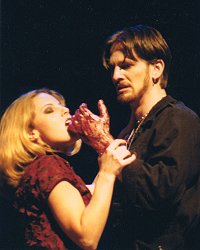 n this hunger and tells his wife - a woman of men's traits. This further fuels something he probably would've taken back as soon as he thought of it if he had not told her, but under the rules of social pressure, Lady MacBeth drinks the plan as if her own. Sometimes, circumstances overtake the heart's will, and if your wife is pressing and the chance comes along - slaying the king isn't such a bad idea...if you don't sit and think about it for too long. Unfortunately, MacBeth's pondering session cues in a scene too late and his hallucinations become a reality. Like many crimes, the consequence and punnishment ringing in your ear is merely the rush of adrenaline & ambition that drives you to the insane edge of commiting it...something an offender will never see the same again.
Subscribe to:
Posts (Atom)